KQED, Uncategorized

‘The Last Black Man in San Francisco’ and his White Friend

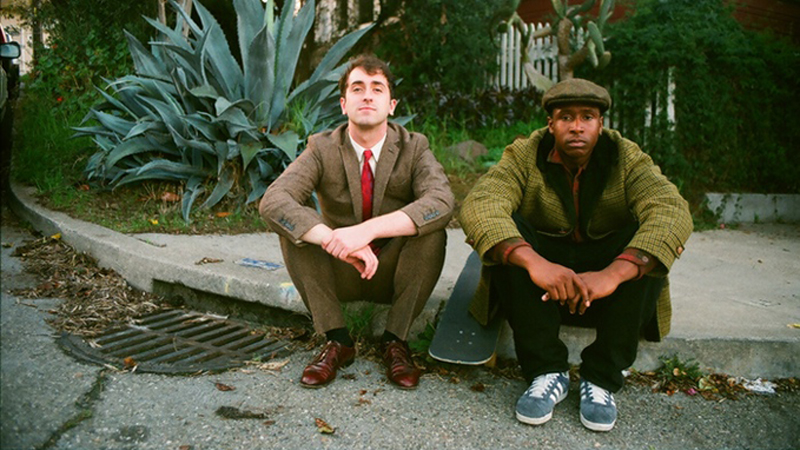
If you were at the San Francisco International Film Festival last week, you may have seen the teaser trailer for The Last Black Man in San Francisco. As a part of the festival’s Boomtown: Remaking San Francisco program, this film-in-the-making highlights issues of gentrification through the “fantastical retelling of Jimmie H. Fails’ true-life story.” The narrative focuses on Jimmie’s dream of buying back his childhood home in the Fillmore. While the film is an accurate depiction of Fails’ relationship to a booming San Francisco, it is his real-life friendship with the director, Joe Talbot, that may seem stranger than fiction to some.

“The Last Black Man in San Francisco” from Joe Talbot on Vimeo.

“When people see us walking down the street together they think we’re an odd pair,” said Talbot of himself and Fails. Fails interjects, “Just because I’m a tall black guy and Joe’s white. Why would that be weird? If you know us, then you know it’s not weird.”

Talbot first recognized Fails’ “natural presence” on film when he was just a kid documenting Bernal Heights goings on with a Hi8 camcorder. Fast-forward 12 years and the duo are still at it with a bigger vision and a deeper friendship.

It was the long walks Talbot and Fails took through “the roller-coaster hills of Bernal Heights” that inspired this project. As Talbot came to know Fails’ life story — shaped by upheaval throughout San Francisco — the more strongly he felt it needed to be told.

Talbot believes it is precisely because Fails grew up in so many “different worlds” within San Francisco that he is able to have a distinct personality in this film while also speaking to the universal feeling of being an outcast.

A close up the "Where's Jimmie" t-shirt The Last Black Man in San Francisco made for the film's Kickstarter campaign. (Courtesy of Joe Talbot)
A close up the “Where’s Jimmie” t-shirt The Last Black Man in San Francisco made for the film’s Kickstarter campaign. (Courtesy of Joe Talbot)


Continue reading on KQED Arts:

‘The Last Black Man in San Francisco’ and his White Friend

Standard
KQED, Uncategorized

My Year-Long Nicolas ‘Cage Rage’

If you’ve watched any movies in the past thirty years, chances are you’ve seen at least one featuring Nicolas Cage. In 2014, I watched more movies featuring Nicolas Cage than movies not featuring Nicolas Cage . . . on purpose. After “Cage Raging” for 12 months, I have still only glimpsed a small portion of the nearly eighty movies Nicolas Cage has acted in since 1981.

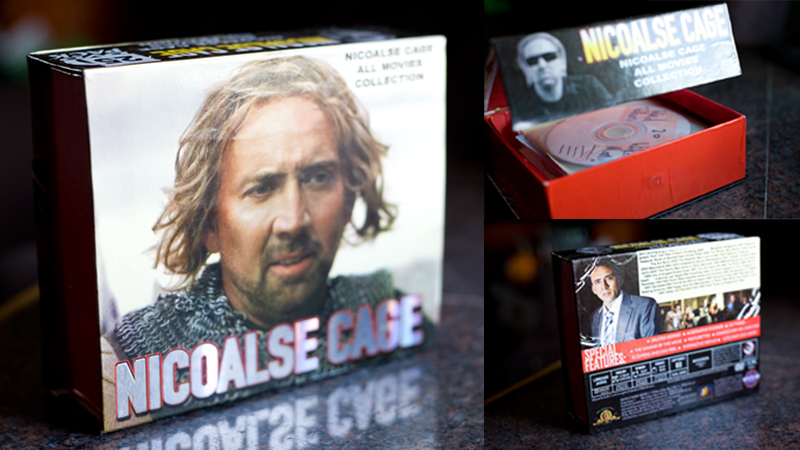
Around this time last year, my friends and I opened a package at a holiday party sent to us from Afghanistan by a mutual friend stationed there with the U.S. Army. Under an array of colorful pashmina scarves, we discovered Nicolas Cage’s face staring up at us from the bottom of the box.

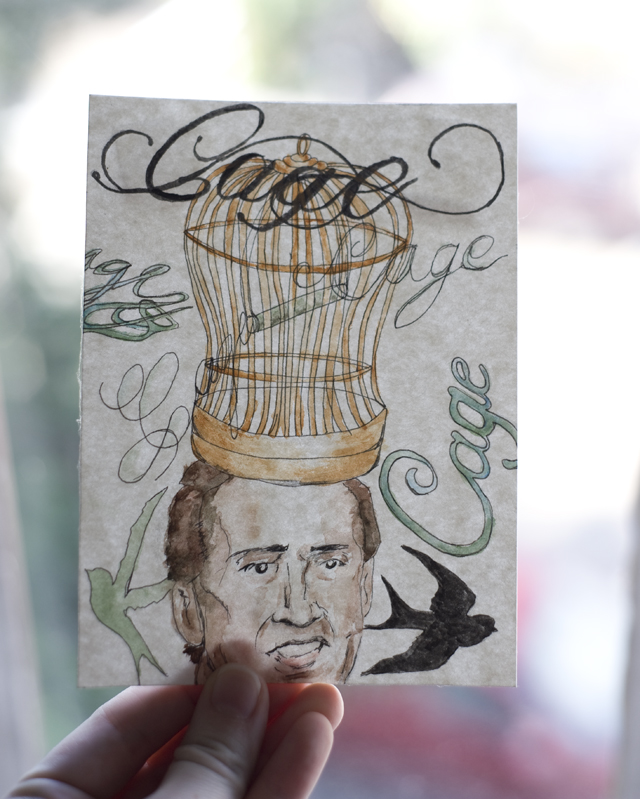
Tal Kamran, Nicolas Cage Fan Art, 2014.
Tal Kamran, Nicolas Cage Fan Art, 2014. (Adrienne Blaine)

Our initial shock was followed by confusion and glee as we realized our friend had sent us a “Nicoalse (sic) Cage All Movies Collection” box set. The exact provenance of this particular box is indeterminate, however, it contains twenty-five plain DVDs with handwritten numbers, which you can draw your own conclusions about.

Although there is a long list of titles on the outside of the box, we never knew which movies to expect on each disc. Most marathoners opt for the Cage cult classics, such as The Wicker Man, Con Air or Face/Off, which feature Cage at his rage-y-ist. But we diligently sat through blockbuster movies (National Treasure), kids’ movies (The Sorcerer’s Apprentice) and movies that didn’t even appear to have Cage in them (Grindhouse).

It wasn’t until we encountered Captain Corelli’s Mandolin that we finally broke down and watched the majority of the film on fast-forward. For this slow-moving period film, watching Cage move and speak at double speed was not so different from the Cage we had come to know and love in other films. See the video below for supercut of Cage’s notable freak-outs (warning: contains explicit language).


Continue reading on KQED Arts:

My Year-Long Nicolas ‘Cage Rage’

Standard
KQED, Uncategorized

Jeffrey Blankfort Celebrates 80th Birthday by Putting His Historic Bay Area Photos Online

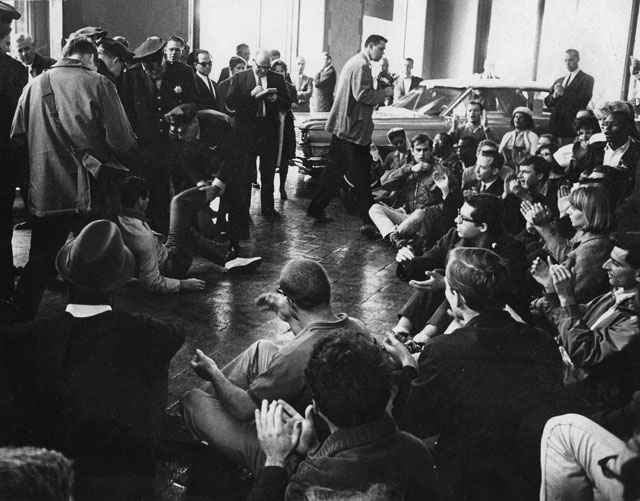
“Look at this guy wearing white bucks! He’s got white bucks on and the cops are dragging him away by the leg” exclaims Stephen Ehret, chuckling to himself as he clicks on a photograph of a 1964 San Francisco sit-in. “That’s a great picture. We need to get that up on the website,” Ehret observes.

Jeffrey Blankfort, whose photograph we have been discussing, turns to me and says, “See? This is what happens; there are too many photographs to choose from.”

1964 sit-in at a Cadillac dealer in San Francisco; Photo by Jeffrey Blankfort

We’re sitting in Ehret’s Sausalito art studio among large-scale paintings of California landscapes. Ehret uploads scanned images to his friend’s online portfolio, which went live for the first time this year in honor of Blankfort’s 80th birthday.

As Ehret clicks, Blankfort regales me with stories of his photographic adventures, “You’ve got to tell me when to stop, I could go on forever,” Blankfort laughs.

In the early 1960s, “before anybody had long hair,” Blankfort got his start as a photojournalist by documenting San Francisco sit-ins. These NAACP demonstrations, like the one the buck-clad protester attended at the former Cadillac Agency on Van Ness, were a part of a critical effort to end racist hiring practices in the city, not only at car dealerships but also at hotels and restaurants.

“There are kids that go to school in the city and don’t know anything about the sit-ins. It’s a crime,” says Blankfort. This outrage drives Blankfort to share his photographs with the next generation to fill in the gaps in what he calls “sanitized history.”

Since the beginning of his career, Blankfort’s photographs have been shown in galleries and published in periodicals, books and retrospectives around the world. After getting his teaching credential later in life, Blankfort discovered his photographs could take on new significance in the classroom.

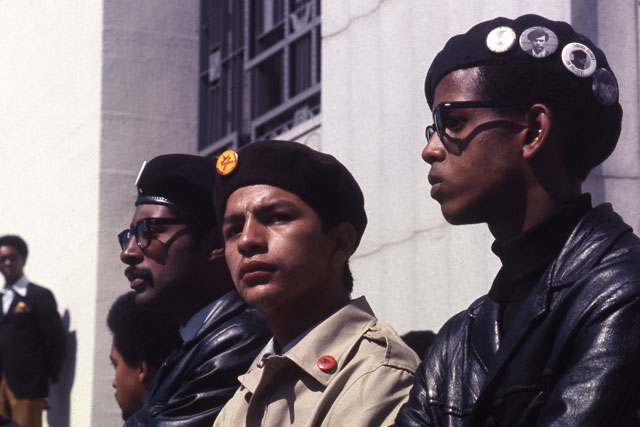
At Richmond High School, Blankfort’s pictures of the Black Panthers and the Brown Berets bridged the gap between history and modern struggles for many of his African-American and Latino students.

Brown Berets and Black Panthers in Oakland, 1968; Photo by Jeffrey Blankfort

Blankfort says, “The black students did not want to hear about Martin Luther King, but when I talked to them about the Black Panthers, some of them had family in the Panthers, and suddenly they wanted to listen. And the attitude of the class changed so much when I would bring my photographs in. They didn’t relate to the South, they related to what went on in the Bay Area.”

Continue reading on KQED Arts:

Jeffrey Blankfort Celebrates 80th Birthday by Putting His Historic Bay Area Photos Online

Standard
KQED, Uncategorized

Finnish Art Icons: Tove Jansson and her Moomins

“Moomin” is a word Walt Disney wanted exclusive rights to in the 1950s. The significance of this word may puzzle Americans, but for millions of children around the world, it needs no translation.

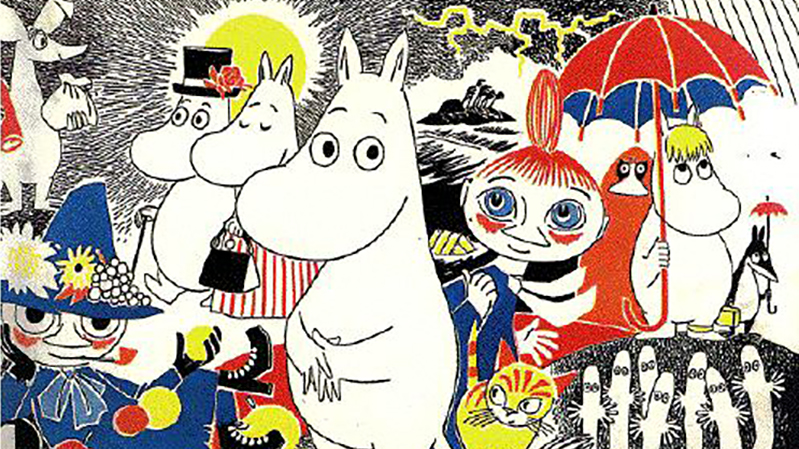
Technically Moomin is a nonsensical word, but it’s also the name of a hippopotamus-like creature who lives in a place called Moominvalley with his family of Moomintrolls.

“Moomin is probably the most known and adored Finnish icon, if not before, then right after Santa Claus,” according to the Official Travel Site of Finland.

In fact, Moomins pop up in the most unexpected places: Finnair’s airplanes, Japanese catalogues, even in Björk’s music video. Once you start seeing Moomins, you can’t stop seeing them everywhere.

Moomin began as a caricature of Immanuel Kant, drawn on a bathroom wall by the Finnish visual artist, illustrator and author Tove Jansson during an argument with her brother. In the 1940s, the caricature evolved into the cuddly, and not entirely un-philosophical Moomintroll family.

Moomin is the main character of Jansson’s comic strip, which follows the whimsical Moomintroll family on various adventures as they subvert their “very ordinary middle-class life.” The family is made up of practical Moominmamma and eccentric Moominpappa, their romantic son Moomin, and his flighty girlfriend Snorkmaiden.

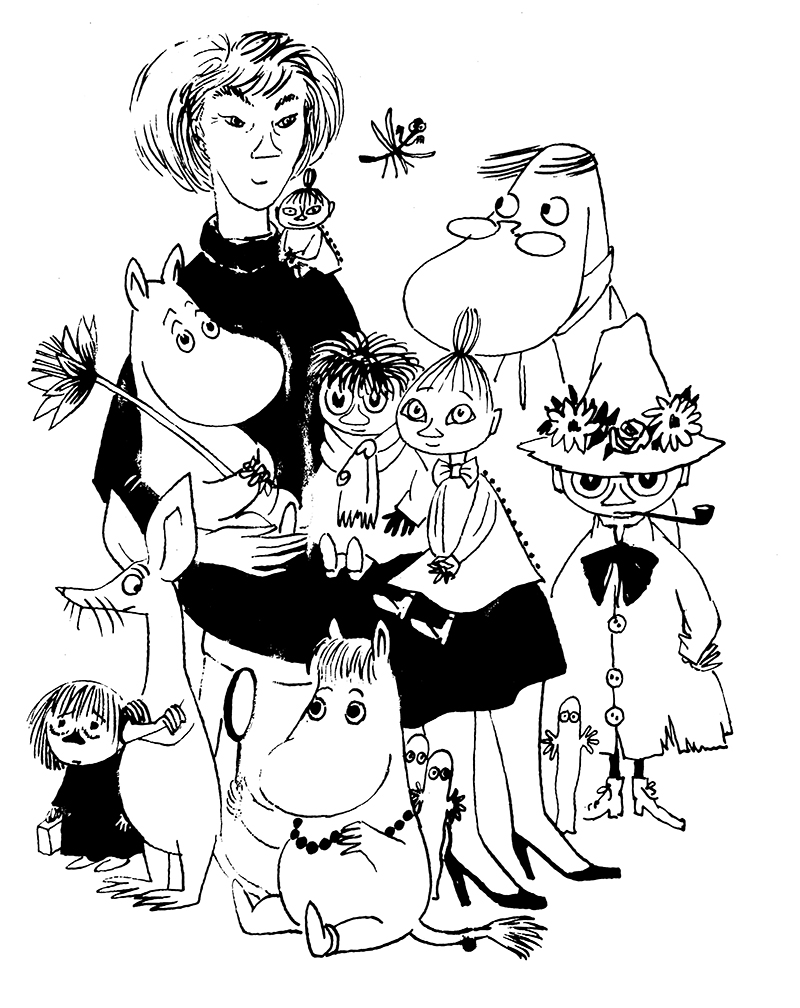
Tove Jansson, Self Portrait; courtesy Tove 100
Tove Jansson, Self Portrait ( courtesy Tove 100)


Continue reading on KQED Arts:

Finnish Art Icons: Tove Jansson and her Moomins

Standard